
Low Libido Is a Clinical Indicator: Estrogen Deficiency & Aversion
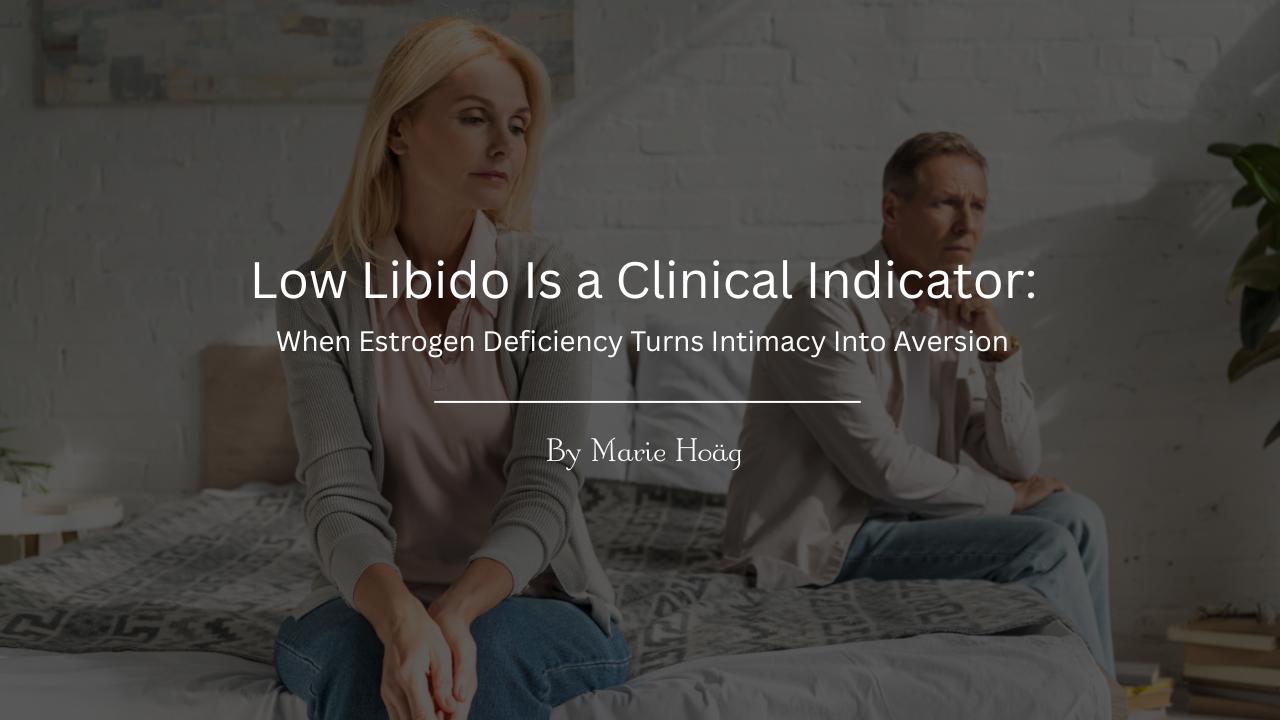
Most “low libido” conversations are built on the wrong premise: that desire is a mindset problem you can solve with tips, tricks, and effort—lingerie, lubricants, date nights, better communication, maybe a vacation.
That approach fails a huge percentage of women for one simple reason: it treats libido like a relationship or lifestyle issue when it’s often a biology issue—specifically, estrogen deficiency.
What women actually say in the clinic
Women don’t come in saying, “I need spice.” They come in saying things they’re afraid to admit out loud:
- “I feel numb.”
- “His touch makes me want to cringe.”
- “His voice irritates me.”
- “I’m scared I don’t love him anymore.”
- “I never want sex again… and I don’t even want to want to.”
These are common. Women say them shamefully and sadly. They’re anxious because they know what it can mean for their future—and that stress can further impair ovarian function and reduce circulating estrogen.
Low libido is often a clinical indicator that estrogen has fallen too low for the brain and nervous system to remain stable, receptive, and connected. When estrogen declines out of a woman’s “sweet spot” range, she may not simply lose desire—she can develop aversion. Intimacy stops feeling intimate. It starts feeling invasive.
We take low libido seriously—clinically
In advanced female hormone medicine, low libido is not a throwaway symptom. It’s one of the 50 clinical indicators we track—along with blood labs—to assess whether a woman is actually hormonally balanced.
We don’t treat libido loss as “normal aging” or a relationship issue to work around. We treat it as data: a signal that estrogen (and sometimes other hormones) may be deficient.
When you view libido through that lens, the question changes from:
“What’s wrong with me?”
to:
“What are my clinical indicators and blood labs telling me?”
Libido isn’t just about sex. It’s about self-state.
Libido is not a switch you flip. It’s a downstream output of your internal state—and that state is strongly influenced by estrogen.
When you feel calm, resourced, emotionally buffered, and physically comfortable, desire is possible. When you feel depleted, irritable, flat, anxious, or emotionally raw, desire often disappears—not because your relationship is on the rocks, but because your nervous system is under-resourced.
That’s why many women say libido loss isn’t even about sex. It’s about how they feel about themselves.
When estrogen is low, women often report:
- depression or emotional flatness
- anxiety and internal agitation
- irritability and low tolerance
- low self-esteem and low self-worth
- loss of motivation and pleasure
- feeling “dead inside”
When a woman feels this way, sex can feel exposing. It can feel like a demand. It can feel like the last thing she can tolerate—even if she goes along to keep the peace.
Why estrogen changes everything.
Estrogen is not a “hot flash hormone.” It is a brain and whole-body hormone.
When a woman has enough estrogen, she can experience stronger emotional buffering, better stress tolerance, improved resilience, sharper problem-solving, and a greater capacity for connection. When estrogen becomes deficient, women commonly describe the opposite: more reactivity, more overwhelm, more withdrawal, less coping capacity, and less tolerance for closeness.
This is where diminished sex drive becomes clinically meaningful. It isn’t just a bedroom complaint. It can be a sign that the brain is craving estrogen.
When a woman is estrogen-deficient, neurotransmitter systems that govern reward, mood stability, and threat sensitivity can destabilize:
- Dopamine (reward, motivation, “wanting”) can go quiet → desire collapses
- Serotonin (emotional buffering, stability) can destabilize → irritability, anxiety, negative bias rise
- Norepinephrine (arousal, alertness) can dysregulate → the nervous system runs “on edge,” and touch can register as overstimulation
When those systems aren’t supported with enough estrogen, intimacy can flip from “reward” to “threat.”
Partner repulsion isn’t “truth.” It’s a pattern.
Women are ashamed to admit it, but the pattern shows up clinically again and again:
- “I feel repulsed at the thought of having sex with him.”
- “I don’t want him to touch me.”
- “I cringe when he walks into the room.”
- “I used to love his smell, and now it makes me gag.”
- “I avoid intimacy at all costs.”
Many women describe their “sex signaling” as going offline when estrogen is low—and returning when estrogen becomes plentiful again. They describe feeling less magnetic and less receptive in low estrogen states, and more alive, responsive, and connected when estrogen is restored.
What matters is not the label. What matters is the pattern: when estrogen is low, a woman’s body can stop interpreting closeness as safe or pleasurable—and start interpreting it as intrusion.
The most dangerous part is what women do next: they assume it must mean the marriage is over. They interpret a deficiency state as identity and destiny.
That is a mistake I see far too often.
The family ripple effect is real.
This doesn’t stay between you and him.
When a woman is depleted, irritable, shut down, or in a global “don’t touch me” state, the emotional climate of the home changes. Kids feel it. Husbands feel it. Everyone starts adapting to tension and disconnection—even if no one names it.
Marital partners are interconnected. When connection erodes, the household becomes less stable. When connection returns, the home often calms down.
This is one reason having a low libido matters. It’s not just about sex. It’s about a woman’s capacity to feel happy and like herself—and show up with warmth and resilience.
How conventional medicine handles this—and why women stay stuck
Most women who raise libido concerns are offered some mix of:
- normalization (“it’s aging,” “every woman goes through it”)
- lubricants and “spice” strategies
- psychotherapy
- antidepressants and psychotropic drugs
- and if hormones are prescribed, a low-dose protocol with an unspoken ceiling
Here’s the problem: women are often treated as if the goal is “some improvement,” not full restoration of brain and whole-body function.
So women remain symptomatic. They assume it’s them. They assume they’re difficult or cold. They assume the marriage is the problem.
In many cases, the real problem is simpler: they are estrogen-deficient.
“I’m on HRT and it’s not working.”
This is one of the most common statements I hear—and one of the most important clinical statements a woman can make.
Being “on HRT” is not the same as having enough estrogen.
If a woman starts hormones and feels a brief lift—then the effects fade—she often assumes hormones don’t work. Clinically, we often see a different explanation: she never reached a sustained state of estrogen adequacy. She was underdosed.
Underdosed estrogen may take the edge off for a while, but it won’t rebuild the internal state required for connection and desire.
What restoration actually looks like.
When a woman’s empty estrogen tank has been fully restored, libido often returns—but typically after the nervous system stabilizes.
Women frequently report improvement in this order:
- internal calm and less agitation
- improved sleep
- emotional stability and patience
- energy and resilience
- then: desire, receptivity, and “chemistry” begin returning
That’s why bedroom advice fails. You cannot “date night” your way out of deficiency.
Libido is often not the first domino. It’s the later domino—once the brain gets enough estrogen.
The bottom line.
If your libido is gone and intimacy feels invasive, don’t let anyone reduce your experience to a relationship flaw or a mindset issue.
Ask the more clinically intelligent question:
Is my brain estrogen-deficient—and am I being underdosed?
Because for many women, restoring estrogen adequacy doesn’t just change sex. It restores self. And when the woman returns, connection can return too.
If this article described you, don’t keep guessing and don’t keep suffering. Take the Hormone Balance Test so you can see how your 50 clinical indicators are scoring.
Start here: advancedhormonebalancing.com


References:
Bendis PC, Zimmerman S, Onisiforou A, Zanos P, Georgiou P, et al. The impact of estradiol on serotonin, glutamate, and dopamine systems: a review. Front Neurosci. 2024;18:1348551. doi:10.3389/fnins.2024.1348551. PMID: 38586193.
Cappelletti M, Wallen K. Increasing women’s sexual desire: The comparative effectiveness of estrogens and androgens. Horm Behav. 2016 Feb;78:178–193. doi:10.1016/j.yhbeh.2015.11.003. PMID: 26589379.
Lara LA, Cartagena-Ramos D, Figueiredo JB, Rosa-e-Silva ACJ, Ferriani RA, Martins WP, Fuentealba-Torres M. Hormone therapy for sexual function in perimenopausal and postmenopausal women. Cochrane Database Syst Rev. 2023 Aug 24;8(8):CD009672. doi:10.1002/14651858.CD009672.pub3. PMID: 37619252.
McCarthy MM. Estrogen modulation of oxytocin and its relation to behavior. Adv Exp Med Biol. 1995;395:235–245. PMID: 8713972.
Simon JA. Identifying and treating sexual dysfunction in postmenopausal women: the role of estrogen. J Womens Health (Larchmt). 2011 Oct;20(10):1453–1465. doi:10.1089/jwh.2010.2151. PMID: 21819250.

Join my mailing list to receive the latest news and updates on blog posts, new podcast episodes, in-person and online events, appearances, webinars, and programs.